Choosing between the Mercedes V-Class and the Mercedes Sprinter is one of the most consequential decisions in planning a group chauffeur transfer in Switzerland. Both are produced by Mercedes-Benz, both are equipped to executive chauffeur standard, both share the Mercedes commitment to passenger comfort and operational reliability. They diverge significantly on every other axis: dimensions, capacity, luggage volume, cabin acoustics, ride character, fuel consumption per passenger and ultimately the per-trip price. The decision depends on the realities of the trip — how many passengers, how much luggage, how long the journey, how the cabin will be used during it.
This guide describes each vehicle in detail, compares them side by side, walks through the use cases where each is the correct choice, and ends with a decision matrix that handles the most common chauffeur scenarios.
01The Mercedes V-Class in Detail
The current V-Class, designated W447 in factory nomenclature and most commonly specified as the V300d in chauffeur trim, is a premium multi-purpose vehicle built on a unique platform shared with no other Mercedes passenger car. It measures approximately 5.14 metres in standard length and is offered also in an extended version. In chauffeur configuration, the cabin seats seven passengers — two in row two facing the rear-most seats, three in the rear-most row — with the second row's seats reversible to create the opposing-seat layout that defines the executive variant.
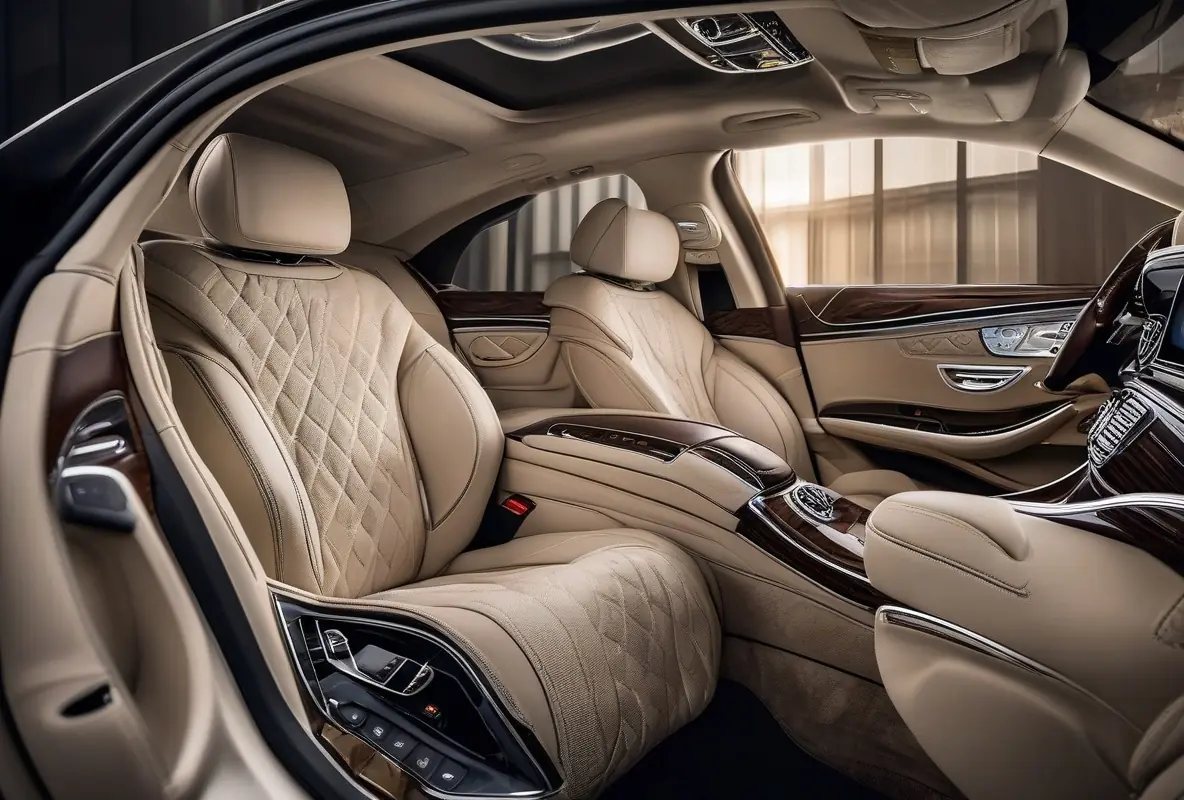
Between the opposing seats sits a folding table that supports laptops, documents, glassware or food during longer transfers. Ambient LED lighting is configurable across multiple colour ranges. Leather upholstery is standard in chauffeur trim; air conditioning is multi-zone; rear sunshades and panoramic-roof variants are available. The cabin acoustic environment approaches the S-Class for noise insulation, with the major difference being a slightly higher floor due to the underfloor mechanical layout.
The drivetrain is a 2.0-litre four-cylinder turbodiesel producing approximately 237 horsepower in the V300d. All-wheel drive (Mercedes's 4MATIC) is available and recommended for winter use in alpine terrain. The nine-speed automatic transmission delivers smooth power application appropriate for chauffeur work. Fuel consumption sits in the low-to-mid teens per hundred kilometres depending on load and route.
Luggage volume is approximately 610 litres behind the rear seats and up to 1,030 litres with the rear-most seats folded. For a group of seven with cabin luggage only, the standard configuration is sufficient. For seven with full-size cases, the rear-most row must usually be reduced to two passengers to allow the third seat space to be folded for cargo.
02The Mercedes Sprinter in Detail
The current Sprinter, designated W907, is a commercial vehicle platform offered in passenger configurations from 8 to 19 seats. Lengths range from approximately 5.9 metres in the shortest variant to 7.4 metres in the extra-long. The standard executive shuttle layout is the medium-wheelbase configuration with 9 to 12 leather seats, climate control, USB power at each seat, and reading lights.
The defining structural feature of the Sprinter is the standing height of the cabin. Adults can move along the central aisle without stooping, which transforms the boarding and disembarking experience for groups, particularly at airport and hotel transfers where the passenger cycle through the vehicle is frequent. The cargo configuration carries more than 14 cubic metres in dedicated luggage variants; in passenger configurations, luggage typically occupies the rear half-metre of the cabin floor and the floor compartment.
The drivetrain is most commonly the 3.0-litre V6 turbodiesel in the executive variants, producing approximately 190 horsepower with a seven-speed automatic transmission. Four-wheel drive is available. Fuel consumption per kilometre is higher than the V-Class but, divided across more passengers, the per-passenger figure is lower.
Cabin acoustics in the Sprinter approach the standard of a premium coach. Road noise is more present than in the V-Class, and the ride character is firmer due to the commercial chassis. The trade-off is more space, more height, more capacity in every dimension.
03Side-by-Side Comparison
Dimensionally, the V-Class is shorter, lower and narrower than the Sprinter. The V-Class's exterior length of 5.14 metres fits in most urban parking standards; the Sprinter's 6.9-to-7.4-metre length requires designated coach or van parking at most destinations.
Passenger count is the clearest divergence: the V-Class seats up to seven in chauffeur configuration; the Sprinter scales from eight to nineteen.
Luggage volume differs by an order of magnitude in the executive shuttle configurations. The V-Class's 600-to-1,000-litre range serves a group of four with full luggage or seven with cabin luggage. The Sprinter handles seven passengers with full luggage, ski equipment for a group, or musical instruments and event-production cases without compromise.
Comfort level reflects the platform difference. The V-Class is closer to a passenger car experience — quiet cabin, refined ride, integrated executive amenity. The Sprinter is closer to an upscale shuttle — more space, more height, slightly more present road and engine character.
Fuel consumption per passenger favours the Sprinter when fully loaded. A Sprinter carrying twelve uses less fuel per person per kilometre than two V-Classes carrying six each. For per-trip total cost, however, a single V-Class for six is less expensive than a single Sprinter for the same group, because the larger vehicle's standby and operating cost is higher.
04Use Cases: When the V-Class Wins
The V-Class is the right vehicle for wedding inner circles — bride, groom, parents, witnesses — where the elegant cabin experience matters more than capacity. The drive to the ceremony, the photo stops, the transfer to the reception all benefit from the executive cabin treatment.
For VIP delegations of four to seven — boards of directors, family offices, senior executive groups travelling together — the V-Class is the standard. The opposing-seat configuration allows the group to hold a working meeting during the transfer, which a saloon or a Sprinter cannot match for proximity and acoustics.
For a family of four to five with moderate luggage — a parent couple, two or three children, a reasonable allocation of cases — the V-Class delivers the appropriate balance of space and refinement. For corporate roadshows where the team travels as a small unit between meetings, the V-Class is the working environment.
05Use Cases: When the Sprinter Wins
The Sprinter is the operational choice for any group of eight or more passengers, full stop. There is no chauffeur vehicle in the Mercedes range that scales beyond the V-Class's seven, and a Sprinter at full capacity is more efficient than two V-Classes operated in parallel.
For groups travelling with ski equipment, the Sprinter is essential. Ski cases do not fit cleanly in a V-Class loaded with seven passengers; in a Sprinter, the ski cases occupy the rear floor and aisle without compromising any seat. For sports teams, race teams and groups travelling with bicycles or equipment cases, the Sprinter handles the load.
For conference shuttles — multiple groups moving between a hotel cluster and a venue across an afternoon — the Sprinter handles the cycle time efficiently. For multi-airport pickups consolidated into a single vehicle — three or four arrivals from different flights, met by one chauffeur and one vehicle — the Sprinter accommodates the variable luggage distribution without rearrangement.
For wedding extended parties — the bridal party, close family, friends being shuttled from hotel to venue — the Sprinter is the right vehicle for the larger group while the V-Class carries the inner circle.
06Luggage Analysis
A V-Class with seven adult passengers and weekend luggage will be at the limit of its cargo capacity. With seven adults and two-week leisure luggage — full-size cases, additional hand luggage — the V-Class no longer accommodates the load. The practical limit of the V-Class for a multi-day leisure trip is five adult passengers, retaining the rear-most seat folded for cargo.
The Sprinter does not encounter this constraint until the configuration moves to the twelve-or-more-passenger variant. For seven passengers with full luggage and equipment, the Sprinter has substantial spare capacity; the cabin remains uncluttered and the passengers do not negotiate space with their cases.
For ski groups specifically: a V-Class with six skiers and their equipment is uncomfortable; a Sprinter with the same six skiers is appropriate. For golfing groups with full bags, the Sprinter handles the equipment without compromise that the V-Class cannot match.
07Comfort Versus Capacity Trade-Off
For passengers, the difference between the V-Class and the Sprinter is immediately apparent. The V-Class feels like a premium limousine — quiet, smooth, with an executive cabin presence. The Sprinter feels like an upscale shuttle — spacious, capable, with a different acoustic and ride character.
For a group of six on an hour-long transfer, where the priority is the executive experience and not the additional space, the V-Class is the right choice. For the same group of six on a multi-stop day with substantial luggage, where the priority is operational flexibility, the Sprinter wins on practical grounds.
08Cost Framework
Per-trip pricing favours the V-Class for smaller groups; the Sprinter is more expensive to operate per kilometre as a standalone vehicle. The crossover point — where the Sprinter becomes more economical than two V-Classes — is reached at approximately seven to eight passengers with substantial luggage. For groups in the six-to-seven range, the decision is comfort-versus-capacity, not cost.
For multi-day bookings, the per-day rates of both vehicles include the chauffeur, the vehicle, fuel and standard operations; the difference reflects the vehicle's class. For repeat bookings, corporate accounts apply consolidated billing across both vehicle types.
09Recommendation Matrix
For two to seven passengers with moderate luggage, where comfort and cabin presence are the priority: V-Class. For four to six passengers with heavy luggage — skis, golf bags, instruments, equipment cases: Sprinter, despite the smaller passenger count. For eight to nineteen passengers, in any configuration: Sprinter. For mixed groups travelling together but with different comfort priorities, two V-Classes operated together can serve where a Sprinter would be the alternative — but the per-trip cost is typically higher.
For weddings: V-Class for the inner circle, Sprinter for the wider party shuttle, coordinated by radio between drivers. For corporate roadshows: V-Class for the team. For ski groups: Sprinter. For conference shuttles: Sprinter. For airport transfers: V-Class up to seven passengers, Sprinter for more.
10Long-Distance Comfort and Multi-Day Routing
For multi-day group transfers, the choice between V-Class and Sprinter compounds across the days. A V-Class on a five-day European routing — Geneva, Lyon, Annecy, Zurich, Munich — delivers a different group experience from the equivalent in a Sprinter. The V-Class fatigue level after twelve hours of road time is lower; the Sprinter offers more room for movement during stops but slightly more road presence in the cabin.
For sleep-quality on overnight repositioning runs, the V-Class with the rear-most seats folded into a flat configuration accommodates two adults sleeping in the cargo area for a non-stop overnight transfer. The Sprinter offers more total space but the seating geometry is not configured for sleep without aftermarket modification.
11Maintenance and Reliability Considerations
Both Mercedes commercial platforms deliver the reliability that defines professional chauffeur service. First Limo's V-Class and Sprinter fleet is maintained to Mercedes service-interval standards with overlay maintenance for premium-fleet operations. Spare vehicle availability across the canton of Zurich and the broader Swiss chauffeur network supports backup deployment in the rare event of a mechanical issue during an active assignment.
12Reserve Your Group Transfer
Contact First Limo for a personal consultation on your group transfer. We discuss the trip, the passenger count, the luggage, the cabin requirements, and recommend the appropriate vehicle — V-Class, Sprinter or a combination — with a fixed-price quote and a chauffeur matched to the assignment.